In this chapter
Election Campaigns
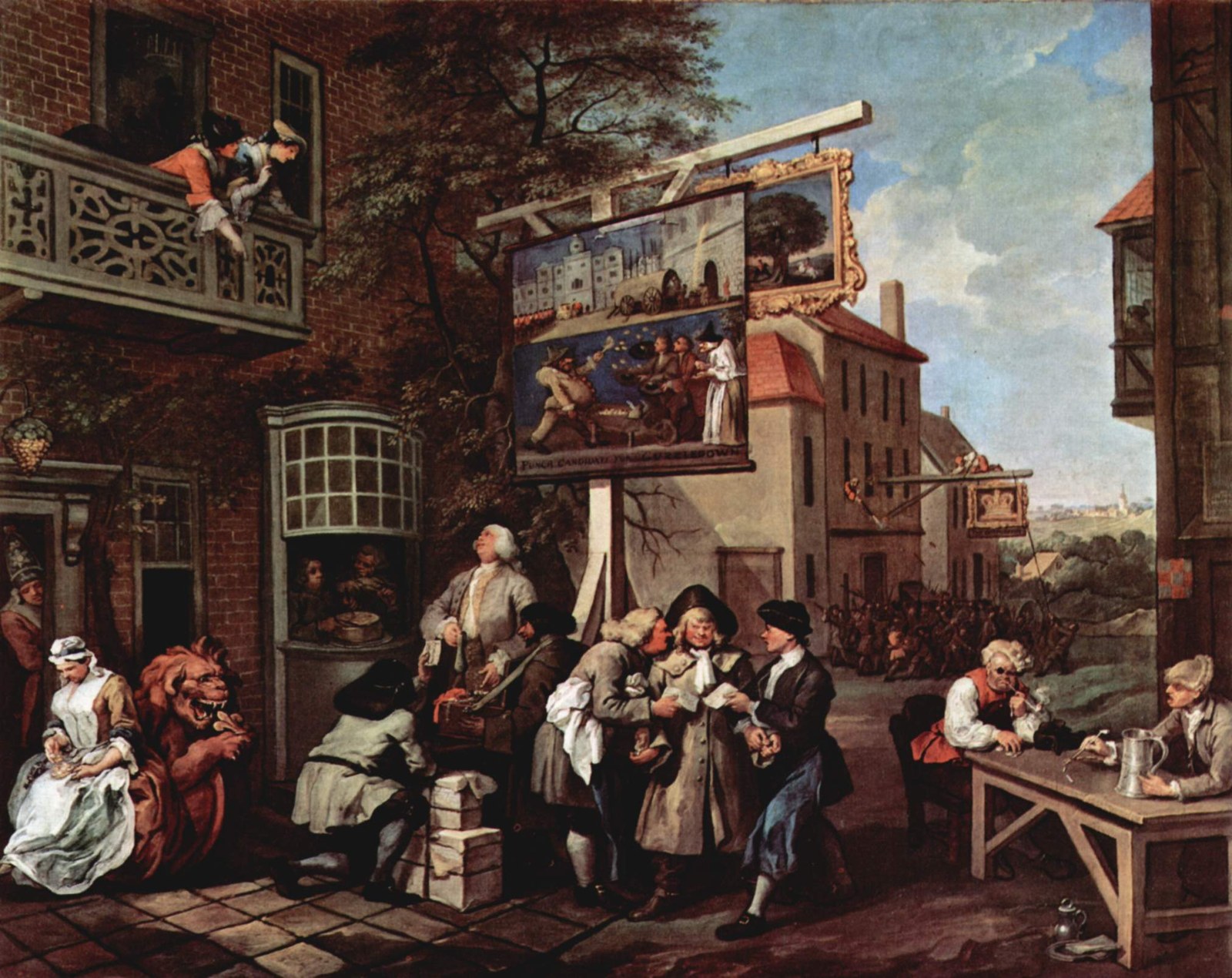
ⓘ
William Hogarth; Sir John Soane’s Museum. Reproduction: The Yorck Project. Public domain. Image source · Rights
The cornerstone of existing “democracies” is supposed to be “free and fair elections”. The actual ruling or governing is done by elected partisans and their appointees. This hierarchical specialization, in which an elite few govern, effectively excludes the public from any meaningful process of deliberation or policy decision-making. The role of the general public is, by and large, limited to the fleeting participation of voting for, or against, those who will govern them. The Enlightenment philosopher Jean Jacques Rousseau famously said the English people who got to elect members of parliament mistakenly believed themselves to be free, yet “as soon as the members are elected, the people is enslaved, it is nothing” (Rousseau [1762] 1997, 114).
Bernard Manin, author of The Principles of Representative Democracy, aptly referred to the restriction of political endeavor to elections alone as “audience democracy” (Manin 2002). This is the reality of electoral politics, even if the commercial media did not exacerbate the problem by reducing political news coverage to what some have called superficial “politainment”. Even for that small minority who feel that they are deeply involved in grassroots politics, “participation” is generally limited to the trivial posting of lawn signs or distribution of brochures, with the crafting of the “message” (let alone the underlying policy) being left to the elites and professionals. Indeed, in many Congressional campaigns, even the candidates themselves are not involved in deciding on issues and message. This detail is often turned over to hired campaign consultants using focus groups, with the candidates merely retaining veto power. These campaign professionals recognize the marketing principle that during a campaign you can’t really engage in deliberation or education.

ⓘ
State Archives of North Carolina, Barden Collection. The source reports no known copyright restrictions.
Image source · LicenseWhile most would agree that policymaking should be based on the complicated facts of reality, elections are based on fiction. The renowned historian and author Yuval Noah Harari observes:
People tend to prefer simple explanations over complicated ones … The truth can be painful, unattractive. We often don’t want to know the truth about ourselves [as individuals or] at the level of entire nations. You know, each nation has its own dark episodes, its own skeletons or cemeteries in the closet that people don’t want to know about. A politician that in an election campaign would just tell people the truth, the whole truth, and nothing but the truth, is unlikely to win many votes. (Harari 2024, 17–25)
As a candidate myself, I learned that the winning strategy is to say what voters want to hear—things that they already feel they know and agree with. Identifying and turning out supportive voters, while suppressing the turnout of other voters, completes the strategy. Electoral politics slides irresistibly toward the art (and now science, as I will discuss later) of finding the most effective emotional hot buttons and “wedge issues” to corral a plurality of voters, from the pool of those citizens who are still willing to vote. And this pool is a minority of adults in most elections in the US. It does no good to plead with, berate or cajole candidates to run upstanding issues-based campaigns. Candidates and their advisers recognize that as a recipe for defeat. As John Gastil notes, “The point here is that such behavior is not irrational, but rather an honest attempt by campaigns to tailor their messages to the reality of the American political environment”. As voter alienation grows and participation declines, civic skills atrophy. “To put it mildly, the American electoral process does not appear to be a self-correcting system” (Gastil 2000, 67).
My home state of Vermont is small enough that most state legislative races are not dependent on TV, radio, or Internet media. But even in this grassroots door-to-door campaign environment, electoral politics is incredibly superficial. Campaigns have almost nothing to do with presenting thoughtful policy proposals nor marshaling superior arguments. I recall knocking on a door during one re-election campaign and having an older woman open it tentatively. I explained that I was her representative and was running for re-election. She squinted at me for a moment, and then said, “I recognize you, you’re one of those singers!” At that time, I was a member of a local amateur a cappella group that performed doo-wop rock and roll. Terry’s doo-wop group Mixed Company · Now… and then
Enlarge album cover This woman had seen us doing a pass-the-hat performance in downtown Burlington and had enjoyed the show. We chatted briefly about her favorite early rock songs, but never discussed any politics. As I clambered down the steps from her porch, she eagerly promised to vote for me in the upcoming election.
Issues may play a role during a primary election within a political party. But even then, rather than policy issues, the dominant “issues” are frequently whether the candidate projects a positive image, seems self-confident, or is “electable”. While Donald Trump’s 2016 presidential primary campaign was anything but typical in many respects, the back seat given to substantive policy matters, while highlighting a few symbolic issues, was typical. In general elections, candidates often simply seek to present themselves in a favorable light, leaving a positive impression with voters.
When I would campaign for re-election, my goal was to show my smiling face at every door, with some stock phrase that indicated I was on the side of the voter against the establishment. If I asked what issues the voter was concerned about, I would generally get a hesitant stare or occasionally hear about some issue that the office I was seeking had no authority to deal with. Unlike many readers of this book, most citizens, and indeed most active voters, don’t think much about politics or public policy at all, and don’t have ready responses to such questions. Indeed, this is also a weakness of most public opinion surveys, which squeeze respondents into one of the available standard responses, based on their off-the-top-of-the-head “opinions”. For decades, politicians knew that in most circumstances it is safer to ask for voters’ opinions or spout platitudes than present any potentially controversial opinions of their own (which may alienate some voters). Most candidates wanted to be known as “the candidate who listens”, regardless of whether the voters had anything to say at the moment.
In recent years, however, an alternative campaign strategy has come to the fore. More extreme candidates in a more polarized environment have stopped trying to appeal to the “median voter” altogether. Instead of seeking to avoid alienating voters, they discount wide swaths of the electorate and instead focus on animating their base with extremist rhetoric. Since most adults, especially moderates, don’t vote in most elections, this “revving up the base” strategy often works through targeted turnout efforts.
My legislative district was a compact urban rental neighborhood within Burlington, Vermont. I could easily walk from one side of it to the other. Campaign techniques naturally change with scale, especially once a campaign becomes dependent on mass media and paid advertising. However, the fundamental shallowness of the campaigns remains the same. Once districts become too large for a candidate to knock on every door in order to create a personal impression, party labels become a dominant factor. Voters commonly state with pride that they “vote for the person, not the party”. In reality, the sheer number of offices that are subject to election in the US means that very few voters know much of anything about most candidates, other than their party, gender and maybe ethnicity gleaned from their name.
Candid doorstep or sidewalk conversation; year if known
Politics based on sortition rather than election could bring substantive policy deliberation to the fore. Certainly, not all residents would deliberate on all issues, but high-quality representative deliberation would occur among those citizens tasked with making a particular decision. Since electoral advantage would no longer be the dominant force among decision makers, the incentive to seek out relative trivia to impugn the motives of opponents, which derives from the need to prepare for the next election, would be gone.
Setting the Agenda
A democracy must have more than merely a good means for making policy decisions (drafting proposals and adopting or rejecting them). It must also have a good means for setting an agenda—deciding which issues to tackle next. The people’s control of the agenda—deciding which “problems” the government will tackle—is fundamental to democracy. Candidates in competitive election situations naturally gravitate to certain issues and ignore others. Likewise, the media have a built-in bias that both mirrors the politicians’ biases (simply by covering the candidates’ press conferences and social media blasts) and adds their own agenda items. These media-generated items are influenced by ratings and advertising pressures. And of course, powerful interests with large amounts of money can place their priority interests on the agenda as well (either the public agenda or the nearly invisible legislative agenda).
Before the vote: what makes the agenda?
Candidates
Issues that help them win
Media
Stories that attract audiences and advertisers
Wealthy interests
Power to put private profit ahead of public need
Decisions about what problems don’t get onto the public agenda are generally more grievous than the decisions about those few that do. As Murray Edelman explained in Constructing the Political Spectacle, “Perhaps the most powerful influence of news, talk, and writing about problems is the immunity from notice and criticism they grant to damaging conditions that are not on the list” (Edelman 1988, 14).
The powerful incentive for elected politicians and their supporters in an adversarial electoral system is to seek out agenda items that give opportunities for vilification of the opposition. Since it is generally more difficult to rile up voters around genuinely vital but nuanced or complicated policy issues, these crucial issues tend not to become the focus of “politics”. Instead, the public is diverted with largely manufactured battles that are more suitable for sound-bites. This is not to suggest that Democrats and Republicans may not have sincere differences on matters of policy (as well as vast areas of silent agreement). But the “issues” that become part of the public awareness and debate, and on which elections may hinge, are frequently manufactured and quite minor in the grand scheme of things. The child-like simplicity of building a wall on the border with Mexico is merely a flagrant example of this general dynamic. Selecting issues that are based on the implied or stated “evils” of the other party is particularly beneficial and more useful for voter mobilization than proposing policies of one’s own. Slogans are a step down from issues and are almost always intentionally vague. I half expect to see some candidate run with the self-referential slogan “Vote for me, the candidate whose slogan means something!”
The electoral system also encourages a tactical focus on knee-jerk “wedge issues” while intentionally ignoring complex long-term critical policy challenges. This tendency springs from the logic of the electoral system, where candidates seek to differentiate themselves with simple, emotional issues that do not require much explanation. The news media exacerbate this emphasis on easily digestible “news”. Austrian Sociologist Manfred Prisching describes the symbiotic relationship as follows:
Politicians know the rules for creating audience attentiveness, as media personnel know how to create a permanent stream of impressive “news”. There is a common logic for both partners in this game. They cooperate in producing “symbolic politics”, pseudo-events, political entertainment … [A] world of simulacra is produced. The fictitious world becomes the real world, and reality is dwarfed by the staged events. (Prisching 2010, 200)
The media focus on the electoral “horse race” and candidates’ nosing ahead, or falling behind. Even outside world events are frequently squeezed into this frame, as helping or hurting particular candidates. This makes for an easier “story” than discussing the complexities that underlie issues. Will the rise in gas prices hurt the incumbent? Is the rise in unemployment good for the challenger? Media analysis of political speeches and campaign debates generally comes down to an evaluation of their performance quality. Stagecraft trumps content. Did the candidate come off as both likable and in charge?
While the media certainly focus on—and the public is most aware of—the partisan battles, in fact, much of what Congress does, or refrains from doing, is the result of bipartisan consensus. But this consensus is rarely the result of any deliberation. In many cases, this consensus is even more insidious than partisan gridlock. There are vast areas of policy in which there is virtually no deliberation and no significant difference between the two major parties. Whether the issue is funding military operations in other countries, extending the government’s surveillance powers, or attending to the interests of Wall Street billionaires, this bipartisan consensus is rarely subject to significant debate in Congress. There will often be a few individual members who object (e.g. Sen. Bernie Sanders on the left and Sen. Rand Paul on the right), and the public might not agree, but as long as the leaders of Congress don’t argue about a matter, it isn’t deemed “newsworthy” and doesn’t garner media attention nor thoughtful deliberation. Deliberation requires hearing and being open to novel and opposing points of view. The partisan divide, combined with a deep homogeneity of Congress, generally precludes any meaningful deliberation.
But there are actually two agendas. In addition to the set of issues selected for voter consumption during campaigns, there is another set of issues on which Congress focuses its legislative effort. These are not necessarily “sexy” hotbutton issues, but are still fundamentally driven by the electoral imperative. Lawrence Lessig, author of Republic Lost, which addresses the corruption of our campaign finance system, notes that Congress tends to seek out those issues that have the best prospect for generating a flow of campaign contributions (Lessig 2015). These are issues where lobbyists and big money interests have a financial stake.
Lessig gives numerous examples of this, such as the bank debit card “swipe” fee legislation, which he notes dominated the attention of Congress during the first several months of 2011. The issue of what percentage of each consumer transaction merchants should pay to banks when a consumer uses a debit card received more legislative time than the nation’s unemployment problem, climate change, or the two wars the nation was fighting at the time. With banks (on one side) and merchants (on the other) funneling huge amounts of campaign money to try and influence Congress, the issue was tailor-made to fatten the campaign war chests of members. Unemployed workers, future Americans suffering the effects of global warming, and veterans simply couldn’t compete in terms of campaign contributions.
Two agendas
Which issues attract attention, mobilize supporters, and put opponents on the defensive?
Which issues attract organized interests and generate campaign contributions?
The democratic question: which problems do people need government to address?
The manner in which electoral politics establishes an agenda is extremely short-sighted and repugnant. Political scientists have long recognized that it is a mistake to assume that those issues that captivate politicians or journalists are the problems that actually matter most to the populace, or will have the greatest impact on their lives. Issues that the media and politicians obsess over are forced to the front of the public’s attention by sheer repetition. Trump’s wall was again an extreme example. But many issues that the general public might rather deal with, if allowed to set their own agenda, are routinely ignored. It is generally assumed that it is inevitable that elites will establish the public agenda, but the use of sortition opens the door to a new avenue. Just how this might work will be discussed in later chapters.
While issues are occasionally thrust upon legislatures by outside events (like a bridge collapse), much of what is dealt with (or ignored) is determined by an evaluation of whether raising the issue is electorally beneficial to one group of candidates or another. Construction lawyer Barry Lepatner explained to a reporter in a May 2014 interview why state politicians routinely underfund maintenance for bridges and other infrastructure. “Politicians do not think of fixing the underside of a bridge or fixing a road that’s in trouble as a kind of political photo-op, or something they can get mileage on with campaign contributors” (Al Jazeera America News Archive 2014).

ⓘ
Airman Sean M. Crowe / U.S. Air Force. Public domain. Illustrative photograph; not the bridge discussed in the quoted interview. Image source · Rights
Ignoring serious issues is the norm. The Democrats and Republicans together paved the way for the financial crisis of 2008, as they did for the Savings and Loan crisis in the 1980s. Neither party could successfully blame the other (both being culpable), and thus these issues were not useful for campaigning. Raising the issues prior to the impending crises would risk drawing attention to their own responsibility for laying the groundwork. Thus, the issues were expediently ignored. There were warnings, but the issues didn’t have electoral “sex appeal”. Then the financial disasters came to fruition, collectively costing Americans hundreds of billions or trillions of dollars (depending on exactly how that cost is measured).
As a third-party legislator, I and my fellow Progressive Party legislators in Vermont regularly ran into this barrier, preventing consideration of issues that both major parties wanted to ignore. Bills, once introduced, are sent to a committee, where they never receive a hearing. We were occasionally able to raise new ideas by offering floor amendments to other bills, though they had to be ruled germane to the bill by the Speaker of the House. With rare exceptions, by the time a bill gets to the floor for action, legislators will simply defer to the recommendations of the members of their party who served on the committees that worked on the bill, and floor “debate” is merely a ritualized performance.
An instructive lesson about agenda-setting through the use of sortition can be found in the Irish constitutional conventions convened in 2012 and 2016. Randomly selected citizens’ assemblies considered a series of constitutional amendments, including same sex marriage at the first one and abortion legalization at the second. These citizen assembly-recommended amendments were subsequently enacted through a referendum. The fact that these agenda items were advanced by random citizen panels (though the first of these was two-thirds randomly selected citizens and one-third politicians) rather than being products of the elected parliament is revealing. In an overwhelmingly Catholic nation, politicians who faced election were reluctant to place these items on the agenda of parliament itself.
As the Ancient Greeks understood, when elites control the agenda, democracy does not exist. An agenda-setting body of everyday people selected by lot, without ulterior partisan or electoral imperatives, who are given the time, resources, and a full range of expert testimony, is essential for true democracy. The critical failures that result from allowing politicians to set the public agenda are exemplified by the climate change issue. The urgency of dealing with anthropogenic climate change has been known for many decades. The fact that any delay would compound the problem and dramatically increase the cost to address it was also known. Randomly selected ordinary people in a learning environment, such as at the 2019–2020 French Citizens’ Convention on the Climate, have been able to quickly understand why climate change needed urgent action. Sadly, politicians didn’t find climate change to be an electorally expedient issue to tackle, so it was ignored, until changing and extreme weather events proved that the crisis was upon us.
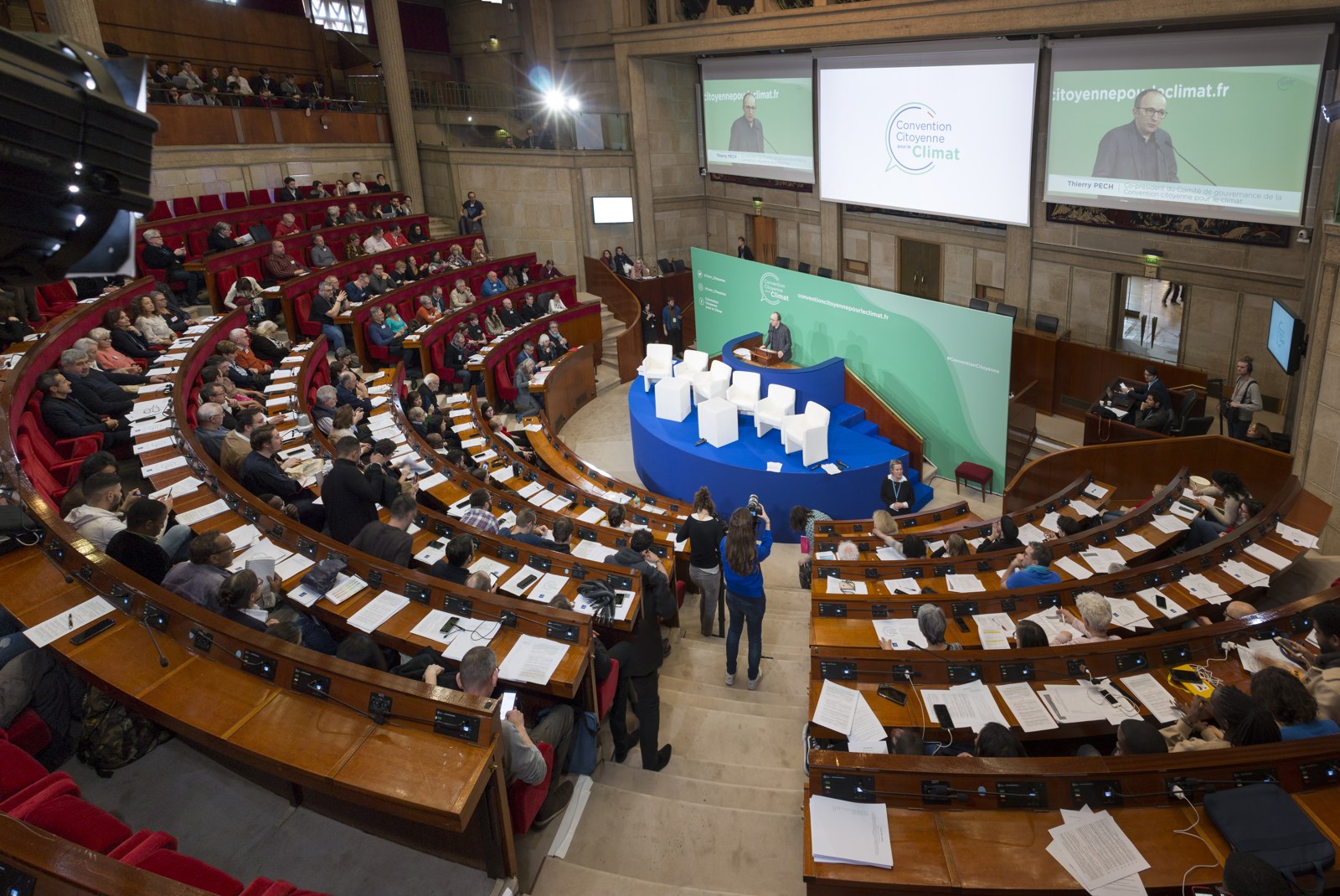
ⓘ
GodefroyParis / Wikimedia Commons. CC BY-SA 4.0. Image displayed without cropping or alteration. Image source · Rights
Planning to Stay in Power
Once an agenda for the current time frame is established, it is vital that an impartial and fact-based means of evaluating policy options exists. Sadly, the interests of society and the interests of politicians are in conflict. In a competitive electoral environment, politicians regularly have an incentive to spread falsehoods or misrepresent facts and policy repercussions. Since the top priorities are re-election and partisan advantage, when the facts are inconvenient or problematic, politicians have a powerful motivation to ignore, distort or lie about them. Elections also have a detrimental effect on a government’s crucially important long-term planning. Politicians rarely look beyond the next election. They are like investment bankers motivated by short-term bonuses that can maximize personal gain while sacrificing long-term global economic stability. US Senator Tom Coburn (R—Oklahoma), in his book The Debt Bomb, observed that “Careerism—the philosophy of governing to win the next election above all else—is the root of almost all that ails Washington. Careerism is the dark matter of the political universe. It is the unseen force that bends decisions, and character, in ways that defy common sense and obvious explanations” (Coburn and Hart 2013, 37).
He has argued that Congress, including staff and lobbyists, constitute a “permanent feudal class”. Campaign expediency regularly trumps long-term needs. Researchers analyzed elections and deforestation in 55 countries in the tropics, from 2001 to 2018, and found that more deforestation occurred in competitive election years. Lead researcher Joeri Morpurgo suggested that this is because some politicians use land and resources to win over voters. There are a lot of laws and regulations against monetary or real estate bribery, but not against the exploitation of nature. Therefore, this is a way to win votes from the agricultural sector, among others. Morpurgo isn’t asserting that competitive elections are completely responsible for deforestation, but the study’s results do suggest that they are indirectly one driving factor (Morpurgo et al. 2023).
Elections are thought to be the appropriate tool for the populace to punish or reward rulers, in order to “hold them accountable”. The issue of “accountability” exists when there is a separation between the rulers and the ruled. But accountability is a double-edged sword. The fear of losing the next election (or more plausibly, of facing a serious primary opponent, given the nature of gerrymandered safe-seat districts in the US) may restrain an office holder from taking bad actions, if the bad actions would also risk being widely known and perceived as harmful by a politically significant subset of their possible supporters. But elections also restrain the office holder from taking good actions that would be extremely beneficial for society. Such actions might be unpopular simply because of inadequate understanding among the populace, but might be extremely popular if all the voters had the information, time and inclination to seriously think it through. But such a popular, detailed examination never happens in an electoral environment. To make matters worse, the politician isn’t facing a neutral, uninformed electorate. The candidate knows that opponents will try to frame the incumbent’s actions as foolish or cruel by cherry-picking facts and prompting voters to take a short-term view.
The example of Ronald Reagan’s campaign against President Jimmy Carter is instructive. Andrew Bacevich, in his book The Limits of Power contrasts Carter’s 1979 so-called “malaise” speech about the energy crisis, the danger of rampant consumerism, and the need for sacrifice and belt-tightening to achieve foreign oil independence, with Ronald Reagan’s “morning in America” campaign theme that Bacevich suggests amounted to telling voters what they wanted to hear— there are simple, painless fixes to long-term systemic problems (Bacevich 2009).
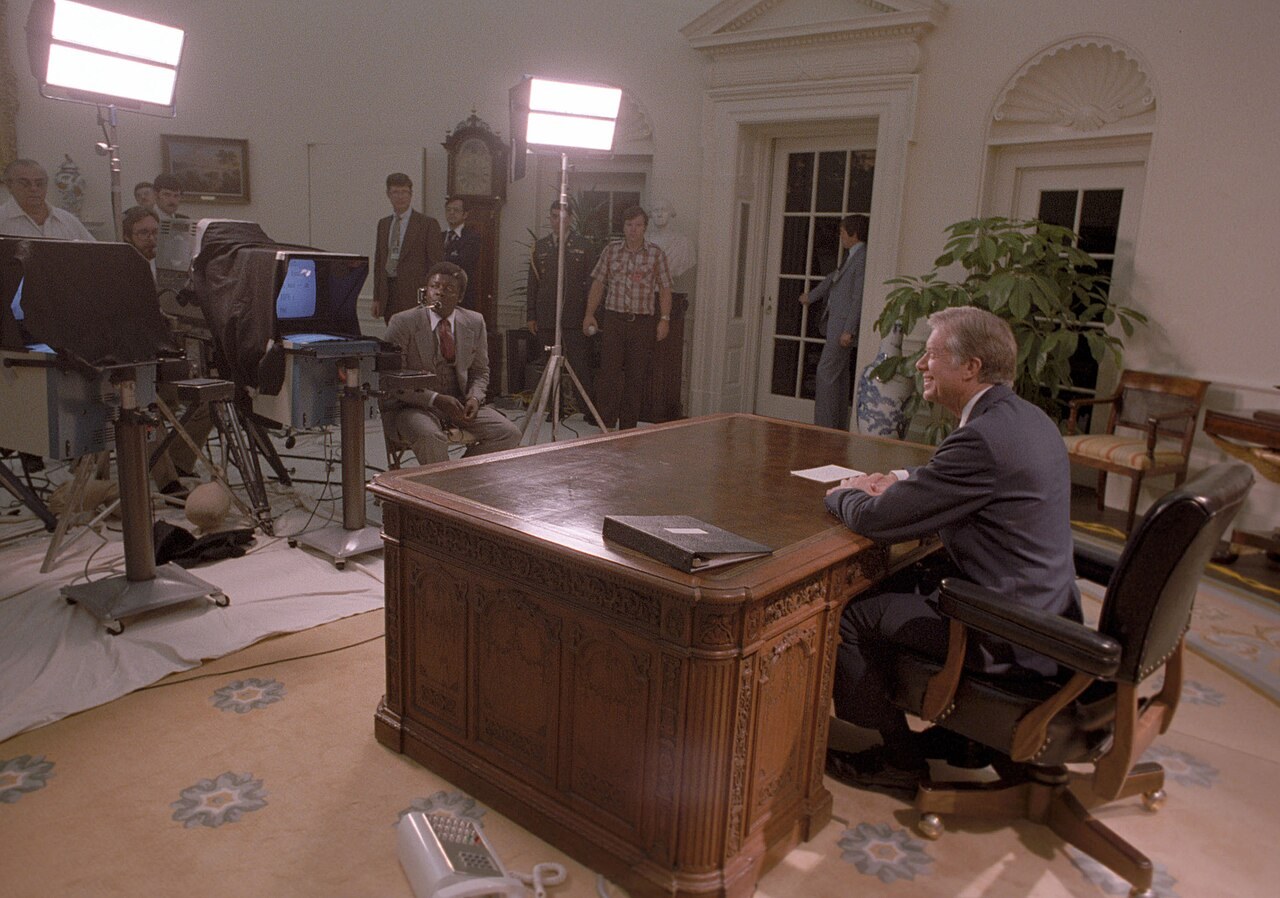
ⓘ
White House Staff Photographers / Jimmy Carter Presidential Library and National Archives, item 6783239. Public domain. Image source · Rights
Reagan’s theme was the winning one. Washington Post columnist Eugene Robinson noted that “while they’re running for office, politicians of both parties encourage this kind of magical thinking” (Freymann 2010). This keeps citizens in a constant state of political immaturity. Political activism and participation are reduced to aggrandizing one or another political celebrity while parroting the talking point of the month, as defined by an elite, rather than dealing with the reality of the governance decisions that need to be made. When looking at long-term issues such as climate change, one could argue that this candidate-driven incentive is the Achilles’ Heel of our electoral democracy (Bouricius 2017b).
Recognizing that a poor economy tends to weaken the election prospects of the party in control of the White House, elected officials of the party “out of power” have an incentive to sabotage the economy through Congressional action or inaction. Faced with a he-said-she-said blame game, voters cannot reliably assign blame, but they know when the economy turns sour. As discussed in the previous section on “throwing the bums out,” the usual response is to punish the party that controls the White House. Some observers blamed Republicans for such economic sabotage leading up to the 2012 elections. It is beyond the scope of this book to evaluate this particular claim, though Senate Minority Leader Mitch McConnell provided some credence to this assessment with his statement in a National Journal interview in 2010 that “The single most important thing we want to achieve is for President Obama to be a one-term president” (National Journal 2010). Whether Democrats intentionally aided the economic meltdown that occurred near the end of George W. Bush’s presidency, or the Republicans intentionally sabotaged economic recovery during Obama’s presidency, the incentive is real. The quote from Paul Krugman at the beginning of Chapter 1 is to the point.
When legislators seek solutions to problems, they naturally seek “politically viable” solutions, remembering the catchphrase that “politics is the art of the possible”. Of course, this generates a feedback loop among fellow legislators and becomes a self-fulfilling limitation—making policy with tunnel vision. Often this means pushing bills that only pretend to address a problem, because a real solution would likely step on toes, so they can’t garner the needed votes in the chamber.
When I was a member of the Vermont House of Representatives in the 1990s there was a statewide grassroots movement advocating single-payer health care reform. Instead of embracing genuine reform, the Speaker of the House helped hammer out a political solution—meaning one that could get a majority of votes. The fact that the plan could not possibly provide universal coverage, nor solve the health care problem, was deemed irrelevant by the Speaker and his lieutenants. The goal was to pass a bill that had the appearance of “moving forward”, so that the members of his party could look good in their upcoming election. Actually tackling health care reform would involve challenging the power and inciting the wrath of insurance and pharmaceutical companies. Better to put on a good show, with the inevitable failure of the reform plan being revealed down the road, and definitely after the next elections. A similar dynamic infected the Clinton effort at healthcare reform and Obama’s Affordable Care Act on the federal level.
Elections foster corruption as well as distorted agenda-setting and poor policy decisions. Elected officials seek to amass power—as both a means to accomplish particular goals, but also as an end in itself. The election process is what legitimates the power of elected officials, and repeated re-election increases that power, through the mechanism of the seniority system, which heaps more power on members the longer they serve. But this very process that confers legitimacy to an elite group who exercise power in society is also a process that taints public policymaking.
Congressional offices place a high priority on constituent service as one tool in the system for maintaining power. Since incumbents can garner fealty from constituents through helping them weave their way through a complex bureaucracy, there is relatively little incentive to fix the bureaucracy or provide non-partisan ombudsmen to assist citizens. It is a better re-election strategy to have one’s staff perform personal favors for many individual voters, rather than fix the system. Non-incumbent challengers can’t duplicate this service.
One Congressional use of power to also build power is the ability to deliver “pork-barrel” benefits to constituents and thus win favor and assure re-election. Many observers have concluded that one of the driving forces behind the federal deficit (even in years when there is no Keynesian stimulus rationale) is the desire of members of Congress to “bring home the bacon” to their districts. This indirectly buys campaign contributions from interests seeking this bacon, and votes from in-district employees of enterprises that benefit. It has been widely reported that major defense contractors spread their sub-contracts around so that as many members of Congress as possible will have some business within their district that is dependent on defense spending. Many observers suggest this explains why members of Congress regularly push for funding military procurement contracts for systems the Pentagon doesn’t even want.
As one example, in 2011 Secretary of Defense Robert Gates testified to the House Defense Appropriations Subcommittee seeking a shift of funds within the Pentagon budget, which he said was essential to protect the lives of soldiers in Afghanistan. According to Washington Post columnist Dana Milbank, Chairman Bill Young (R—Florida) declined to take action, “because Young objects to the money being taken away from the Army’s Humvee program. Never mind that the Army has more Humvees than it wants. They were manufactured by AM General—which happens to be Young’s third-largest campaign contributor. Its executives had funneled him more than $80,000, according to the Center for Responsive Politics” (Milbank 2011).
Bringing home the bacon also brings honors, with the constituents who are beneficiaries having no concern as to how corrupt the procurement process may have been. Indeed, such corruption is regularly celebrated. The retiring Senator Patrick Leahy (D—Vermont) of my home state had a variety of institutions re-named after him. For example, his earmarking $145 million for a small city airport prompted the city to rename the airport the “Patrick Leahy Burlington International Airport”. The University of Vermont (UVM) re-named the Honors College after him—”The Patrick Leahy Honors College.” Utilizing his leadership position on the Senate Appropriations Committee, Leahy helped direct millions of dollars in federal earmarks to Vermont and UVM in particular. In an interview, UVM President Suresh Garimella praised the largesse Leahy directed toward the university, saying Leahy is “perhaps the single greatest benefactor to the University of Vermont”. Trying to calculate the vast amount of money the Senator had steered to the university, he concluded, “At this point, the answer is literally incalculable” (quoted by D’Auria 2023).
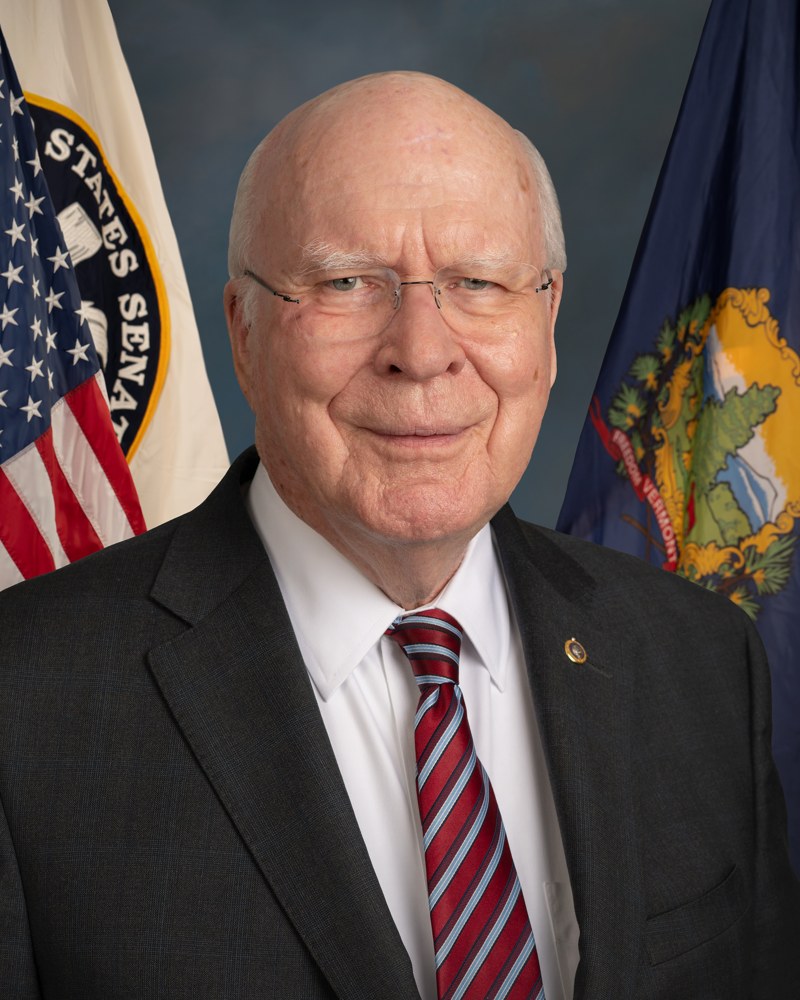
ⓘ
Renée Bouchard / U.S. Senate Photographic Services, 10 June 2021. Public domain. Image source and rights
The fact that this all reflects corruption is revealed by the simple fact that if these money flows were readily justifiable based on merit, through an impartial cost/benefit analysis compared to alternative expenditures, then Leahy’s involvement would not be noteworthy, and no constituent gratitude would be generated.
Pork is not delivered only through earmarked appropriations, but also through other legislative fine points, such as favorably structured tax loopholes. Within the legislative world, these are known as “tax expenditures”, and often fly below the radar of the media and the public. The tax-writing committees have vast power. In the 2008 update of his book, Citizen Power: A Mandate for Change, former US Senator Mike Gravel states: “I hold the view that Congress will never correct our inequitable tax structure because at its core, the existing tax system is about getting and keeping power …” (Gravel [1971] 2008, 33).
There is a well-accepted economic theory that seeks to explain how Congress steadily ratchets up government commitments to various special interests. A favor sought by a special interest, whether a new program, contract, tax loophole, or change of regulations, can have a huge impact on the special interest. It makes sense for the special interest to make the necessary lobbying efforts and campaign contributions to get its way. But because the cost of each individual favor is diffused over a huge population—and the politicians face no costs at all, since they are spending public monies—there is no interest group with sufficient harm, or resources to counter the new federal commitment. Thus, the ratchet effect produces policies that the majority does not favor, but which individually simply aren’t worth actively fighting.1
The concentration of power and its continuation through re-election is an open door for corruption of all sorts. The predictable stability of power being held in certain hands is a fundamental enabler of corruption. Bribery (whether in the form of legal campaign contributions or illegal gifts) is much more valuable when the corrupt relationship will continue. In some cases, an initial bribe is an investment for future favors as well. In other situations, an ongoing position of some authority allows a “gatekeeper” to extract bribes from all comers. The constant rotation of power inherent in a sortition model makes bribery and corruption a much poorer investment, and more difficult to maintain or hide from view.
Along with power comes a set of rationalizations and techniques for maintaining that power. While serving in the statehouse, I repeatedly heard legislators justify actions they would normally have abhorred as necessary to assure re-election. The rationalizations continued with the notion that “bad” actions were actually “good” because they preserved the ability of the legislator to remain in office to do good another day. While there are ethics rules in Congress, which are certainly violated from time to time, much of the existing corruption does not violate any rule or statute. As long as there isn’t a formal quid pro quo selling of a vote, the corrupt, but legal, possibilities are endless. A lot of Congressional corruption is tied to the legalized bribery that we know as the campaign finance system. The importance, but insufficiency, of campaign finance reform will be discussed in a subsequent chapter.
In the field of medicine, iatrogenesis refers to the dynamic in which some medical treatment harms rather than helps, inadvertently causing illness or death rather than preventing it. Our electoral system is iatrogenic, in that elections are thought to fight corruption by allowing voters to throw out the bad apples, but instead elections actively promote corruption in multiple ways, resulting in the entire barrel going bad. Rather than enabling healthy democracy, elections are preventing genuine democracy and harming society as a whole.
Unity, not uniformity, must be our aim.
ⓘ
The New State (1918), p. 39. Follett argues that differences should be integrated rather than suppressed.
Deliberation or Denunciation?
No individual or single group can judge what is best for a society. One of the basic claims of superiority that can be made for actual democracy over oligarchy (whether hereditary or elected), monarchy, etc., is the notion that deliberation among many members of society can lead to better decisions. Hélène Landemore at Yale University, in her book Democratic Reason, Politics, Collective Intelligence, and the Rule of the Many, seeks to uphold democracy on this basic epistemic ground—the collective intelligence of the many allows decision-making that is in general superior to the decisions of even expert elites, who lack the diversity of perspectives and information, as well as cognitive diversity.
Deliberation might entail joint fact-finding, or the weighing of information by many individuals, or the give-and-take of arguments that bring different perspectives to the fore. The benefits and hazards of various methods of deliberation will be examined in subsequent chapters. But for now, it is sufficient to state that deliberation is distinct from mere negotiation or debate. Deliberation involves political equals engaging to learn from each other and change their minds if warranted, in the search for optimal solutions. Unfortunately, electoral politics in America is nearly devoid of meaningful deliberation. As Kevin O’Leary points out, “Most political decisions are based on power calculations having little to do with reasoned debate by free and equal citizens: they are based on arbitrary power …” (O’Leary 2006, 169).
The partisan election process, which constrains and shapes how members of an elected chamber behave, is the underlying impediment. There is a lack of deliberation both during campaigns and within legislative chambers. During most “debates” in Congress, the chamber is virtually empty. Attendance would be a waste of time, since the party whips have usually already done their work, and the outcome is known in advance. Congressional staffers monitor the proceedings so that the members can show up just in time to cast their votes in case of a roll call. When the chamber isn’t empty, what passes for “debate” is almost never intended to persuade other members, but rather a performance for cameras and the press. While less extreme at the committee level, this dynamic is still at play.
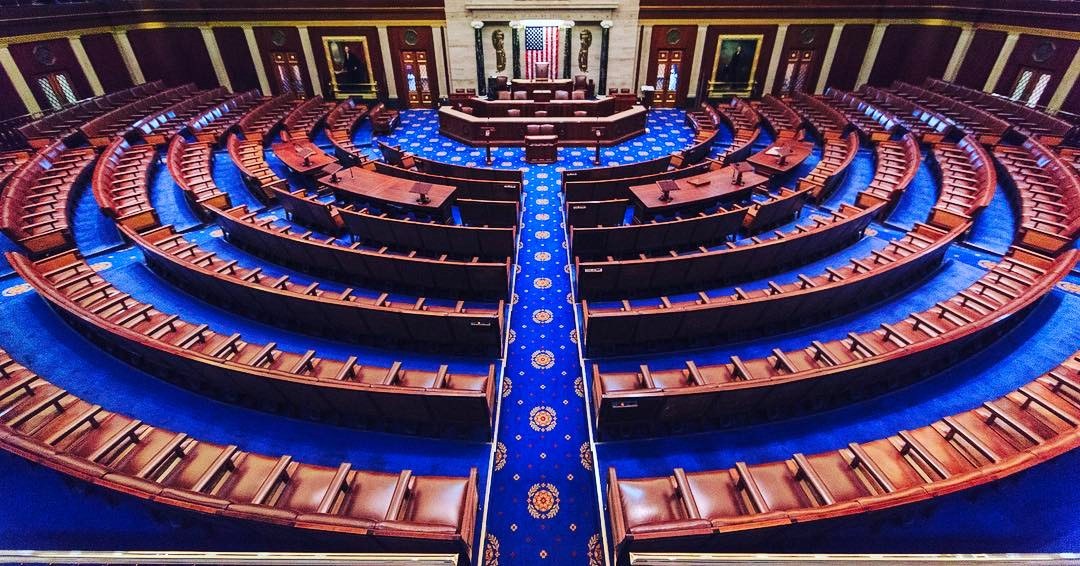
ⓘ
Office of the Speaker of the House / U.S. House of Representatives, 27 February 2017. Public domain. Image source and rights
What little deliberation actually occurs generally takes place out of sight among members of the same party, and more commonly, among their staffers, and lobbyists. When a so-called “bipartisan” compromise exists, it is rarely the result of actual deliberation. It typically consists of either non-controversial items on which there was already agreement, or splitting the difference between prior positions that were adopted in discussions limited to each party’s insiders and lobbyists. Compromise in the sense of seeking a genuine win-win synthesis that brings in new ideas and new perspectives is virtually nonexistent. Floor “debate” is widely understood to be political theater, intended to score points for the next election—with posturing, patronizing and grandstanding. In a November 2018 article in Atlantic magazine, Rep. Mike Gallagher (R—Wisconsin) wrote, “The reality is that Congress cannot get anything done because it is not equipped to get anything done. It is no longer a tool suited to its original purpose of making laws and providing oversight. It has instead become a theater used by both parties to stoke the outrage of their base” (Gallagher 2018).
When I served in the Vermont legislature, I witnessed, and indeed participated in, such theatrics on a regular basis. While nominally trying to persuade my fellow legislators about some amendment in a floor speech, I knew that in the large majority of cases their votes were already locked up one way or the other. I still researched facts and tried to prepare compelling arguments. My speeches might cause the rolling of eyes, but rarely the changing of minds. But it wasn’t personal vanity, nor merely liking the sound of my voice, that prompted me to play my part in these sham debates. My intended audience was the reporters and residents across the state, whom I vainly hoped would hear my arguments and, as a result, understand the necessity of voting the opposition legislators out of office. And, this behavior is even more extreme at a national level. The use of floor debate as a means for consolidating core constituency support rather than for bona fide debate was exemplified in 2011 in a floor speech by Republican whip, Senator Jon Kyl (R—Arizona). In a Senate floor “debate” about defunding Planned Parenthood, Sen. Kyl said that abortion is “well over 90 percent of what Planned Parenthood does.” When it was later pointed out that abortions account for just 3 percent of Planned Parenthood’s budget, his office issued an honest yet astonishing statement simply dismissing the complaint, and explaining that “His remark was not intended to be a factual statement” (Reimink 2011).
Editorial clarification · services, not budget
The historical 3 percent figure cited in this passage refers to Planned Parenthood’s reported services in 2009, not its budget or its share of patients. The original book wording is retained. Read the April 2011 fact-check and its sources.
Added for the online edition · November 2026.
What little inter-party discussion does occur is more likely to consist of bargaining and negotiation based on vote trading, or “log-rolling”, in which the merits of particular pieces of legislation are hardly a factor. There is an important distinction between genuine deliberation and mere negotiation. Deliberation and negotiation are different animals. Deliberation involves giving or receiving arguments intended to persuade. But deliberation should also be distinguished from sophistry that persuades through artful manipulation or intentional deceit without regard to facts. Deliberation involves reasoning together as a means of problem-solving. It requires openness to absorbing new information that changes one’s views, often in hopes of finding common ground—the classic win-win scenario. Negotiation, on the other hand, essentially reflects a determination of a balance point based on the relative strength of the sides, regardless of reason. What substantive deliberation on merits does occur in legislative settings is primarily intra-party (within the caucus), or between lobbyists and legislators, or more often, their staff.
The fact that legislators are always anticipating future elections—whether their own, or their colleagues’—is a powerful incentive to portray the proposals of the opposition as evil, or at least horribly flawed, and intended to benefit the unworthy. This makes collaborative deliberation between members of different parties extremely difficult at best. Robert Kaiser, a long-term reporter and editor at the Washington Post, wrote an incisive book, Act of Congress: How America’s Essential Institution Works, and How It Doesn’t. With nearly unprecedented inside access to the actual law-making process, with Congressional staff and lobbyists, he follows the adoption of the Dodd-Frank Act (Congress’s anemic response to the 2008 financial meltdown) to illuminate the problems. He reveals many of the fundamental flaws that mire Congress in almost perpetual policy failures. Even when members of Congress sort of succeed—in the minimal sense that at least a bill became law—he shows how the ferocious partisan electoral imperative overwhelms policy considerations. As he writes, “most members both know and care more about politics than about substance” (Kaiser 2014, 301).
As a legislator, I remember private conversations about proposals brought forth by opponents. Rather than open-minded evaluation, the overriding concern was “can we find flaws that can make their proposal look bad, and stop them from getting any credit?” Senator Joe Manchin (D—West Virginia), a conservative Democrat, made this observation on a television interview program:
Let me just say, the thing that I’m discouraged about—not just in the Democrat, but in the whole process, Democrat and Republican caucuses—I truly believe that what we’re doing is we’re taking polls, you know, the same as you’re taking polls, where the American people stand on a day to day basis, on what they’re upset about. Rather than taking that information and trying to say “okay guys let’s fix it”. Okay, now by three o’clock “How can we blame [an opponent] for that?” (Manchin 2011)
Of course, many people question the possibility that any politics, deliberative
or not, can find win-win opportunities with any regularity. Often, politics is about choosing between mutually exclusive options that reflect a fundamental divergence of interests. In such cases with inevitable winners and losers, it still makes sense to have those decisions made by a genuinely representative body, rather than one that is corrupt and unrepresentative. However, electoral politics has a built-in tendency to treat nearly all political decisions as such zero-sum games with winners and inevitable losers. Through deliberation and skilled facilitation, some seemingly intractable conflicts can be resolved with broad agreement. This is not mere speculation. Hundreds of citizens’ assemblies around the world have found this to be true.
Mary Parker Follett, a management and organizational theorist from the first part of the twentieth century, advocated an “integrative” deliberation process. Rather than focusing on the apparent conflict, she suggested that it is often possible to dig down to find the underlying desires, where commonality, rather than mere compromise, could be found. In her 1924 book, Creative Experience, she gave this example:
The integrating of wants precludes the necessity of gaining power to satisfy desire. In the library today, in one of the smaller rooms, someone wanted the window open, I wanted it shut. We opened the window in the next room where no one was sitting. This was not a compromise because there was no lopping off of desire; we both got what we really wanted. For I did not want a closed room, I simply did not want the north wind to blow directly on me; likewise the other occupant did not want that particular window open, he simply wanted more air in the room. (Follett [1924] 2013, 184–185)
Beyond “open” or “shut”
The underlying need: more fresh air.
The underlying need: avoid a direct cold draft.
A solution that meets both needs: open a window in the adjoining, unoccupied room.
Modern political theorists Hélène Landemore and Jane Mansbridge have used Follett’s insights to argue that integrative deliberation can sometimes clarify a seemingly irreconcilable dispute. Once the underlying desires have been clarified and rephrased, this sort of deliberation may reveal a cooperative win–win option acceptable to all sides. While beneficial for society, this integrative approach is anathema to partisan politicians who place a priority on winning, or if that is not possible, demonstrating to voters how cruel or foolish the other party is. Seeking common ground isn’t useful for attacking opponents in competitive elections. This isn’t necessarily due to bad intentions. It is more akin to a reflex—seizing a competitive opportunity when presented, due to legislators’ immersion in the competitive electoral environment. Ordinary people selected by democratic lottery do not have this distorting hidden agenda imposed by competitive elections, so they can eagerly employ this integrative approach.
Notes
- As an example, researcher Adam Przeworski and colleagues described why Congress would adopt a subsidy for the sugar industry. “By subsidizing the sugar industry, the government inflicts on each individual an annual cost of $5.75 and benefits the sugar industry to the tune of $1.5 billion. Voters will not want to spend their resources to learn about sugar policy and its effects: this information costs more than $5.75. Then the government will subsidize, get a campaign contribution from the industry, and maximize its probability of reelection” (Przeworski, Stokes, and Manin 1999, 35). ↩ Return to text