“The appointment of magistrates by lot is thought to be democratical, and the election of them oligarchical.”
— Aristotle, Politics, c. 350 BCE
Aristotle distinguishes two ways of choosing public officials: selection by lot, associated with democracy, and election, associated with oligarchy—rule by the few. “Magistrates” here means public officeholders.
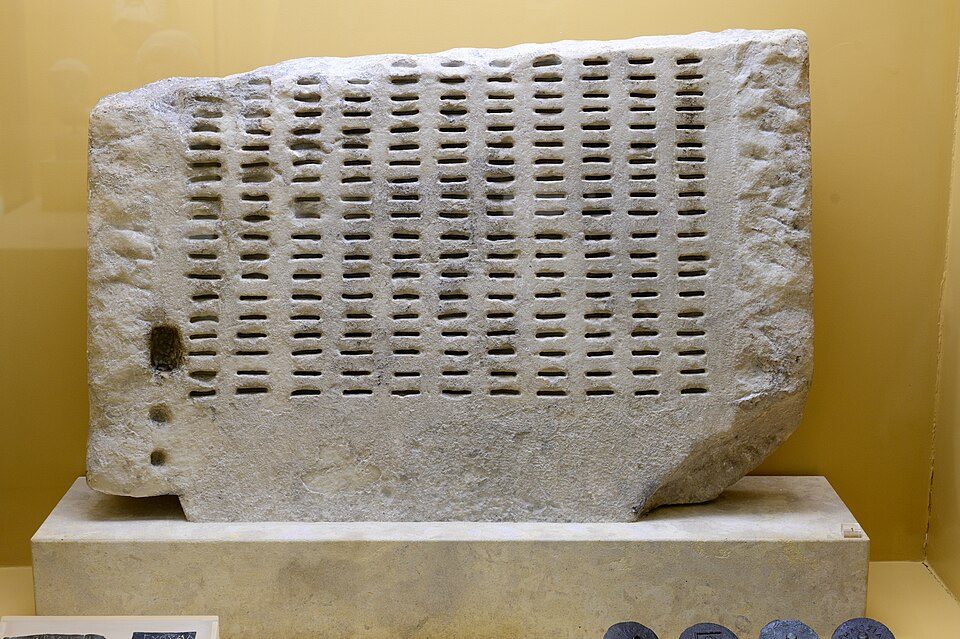
How it worked A citizen’s name went on a small ticket, which was placed in one of the stone’s slots. Black and white counters released from a side tube determined which rows were selected. Think of it as a public jury-selection machine.
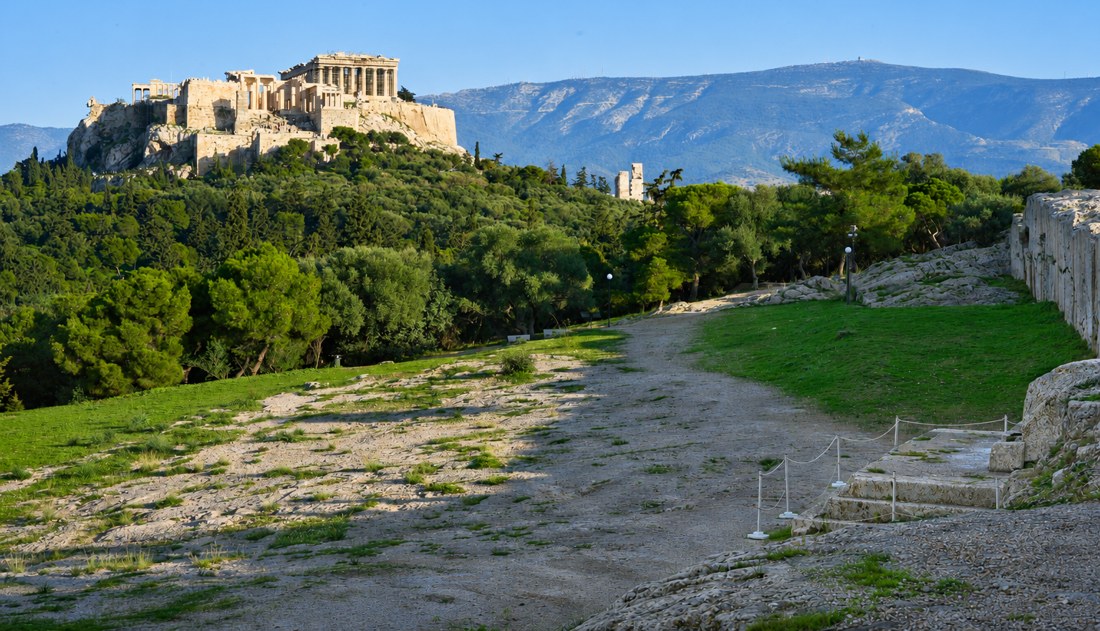
We learn in school about the ancient Athenian mass assembly—the . However, the assembly was not the defining feature of ancient Greek democracy. Many non-democratic Greek city-states, such as , also had such assemblies. But, unlike democratic city-states, such as Athens (and there were many other democracies throughout Greece—it’s just that Athens is the best known and well documented), Sparta’s agenda was controlled by an elite. Sortition was to the Greek democrats. Athenian , the courts (), legislative panels () that passed new laws, and the administrative Council of Five Hundred (), which set the agenda, were all selected from among everyday citizens using this random lot procedure.
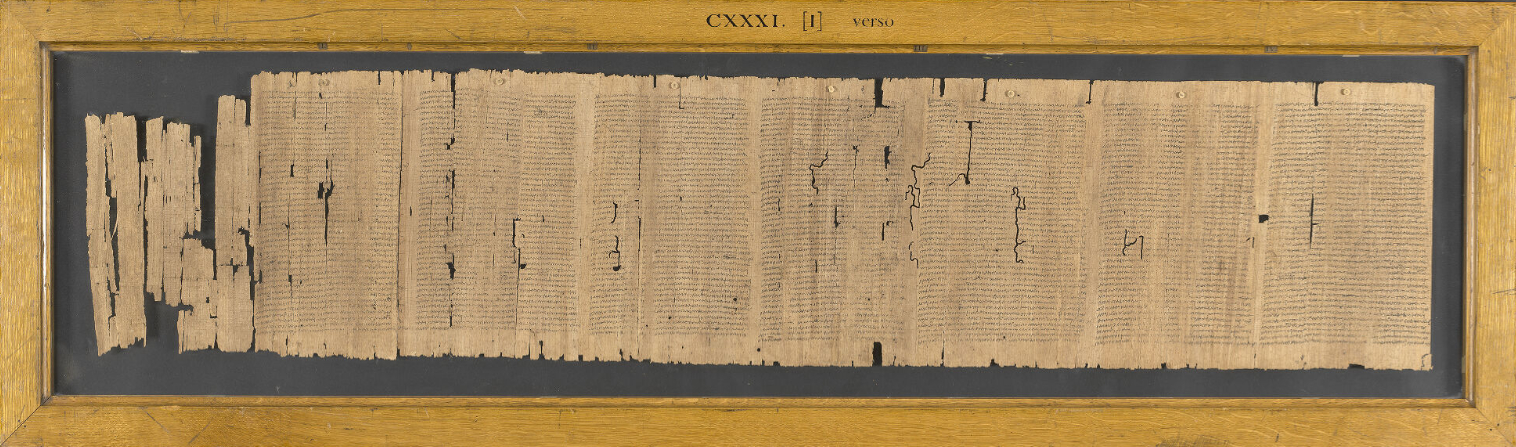
The ultimate democratic system that Athens landed on following the reforms of 403 BCE, stripped lawmaking authority from the Assembly (which was deemed too easily manipulated by , and vested it in large randomly selected legislative panels known as nomothetai, which could spend more time, listen to an equal number of supporters and opponents of a proposed law, and then vote. This is often referred to by scholars as Athens’s fourth century democracy, or “second democracy”, to distinguish it from its earlier fifth century constitution. Historian Mogens Hansen designates it by the title of his authoritative book, The Athenian Democracy in the Age of . The workings of this reformed “second democracy” was essentially unknown to political writers like Rousseau, Montesquieu and Madison, since a papyrus copy of Aristotle’s Constitution of Athens was only rediscovered in the late nineteenth century in Egypt (Hansen 1991).
Papyrus copy of the Constitution of Athens.ⓘ
British Library, Papyrus 131, folio 6 verso; copied around AD 100, not Aristotle’s autograph. British Library / Wikimedia Commons · Public domain.
The political use of the lottery was central to democracy. Classics scholar has noted recently discovered evidence about the centrality of the randomly selected council from another Greek democratic city-state not far from Athens.
In terms of making a participatory Greek democracy work, the key institution was a popular deliberative council [as distinct from an assembly] chosen from the entire citizen body. The Greek recognition of the centrality of a popular council for democracy is underlined by a recently discovered inscription from . In ca. 340 B.C. the Eretrian democracy promulgated a decree offering rewards to a potential tyrant killer, that is, to anyone who took direct and violent action against those who sought to overthrow the existing democratic government. In a revealing passage, the decree orders all citizens to fight without waiting to receive orders if anyone tries to establish “some constitution other than a Council and a prutaneia (a subset of the Council) appointed by lot from all Eretrians. (Ober, 2008, citing Knoepfler 2001, 2002; translation Teegarden 2007)
A recent and far-reaching analysis by Dr. affirms this view, stating that “Our ancient sources [especially the surviving speeches of Athenian orators and Aristotle’s Constitution of Athens] suggest that the most significant and distinctively democratic institution in Athens was the courts, where decisions were made by large panels of randomly selected ordinary citizens …” (Cammack 2013, iii).
Another thing we learn in school is that the Athenian form of democracy is dependent on having a relatively small society, and thus has little to offer as a model for a modern nation-state of millions. It is commonplace to make a fundamental distinction between direct democracy (with Classical Athens as the supposed archetype) and modern so-called “representative democracy”. I contend that all democracies with more than a few hundred members, including Classical Athens, are in reality representative.
Athenian democracy was not based on the principle that all citizens could or should participate in a face-to-face manner in all decisions in the assembly. That would have been impossible in Classical Athens just as it is in large nations today. Some subset of “the people”, selected by lot, stands in for, or represent the people as a whole.
Understanding that Athenian democracy was representative—but not electoral—leads us to an important insight. Most people today dismiss the Athenian system as inapplicable to modern nation-states (or even cities) due to the issue of scale. Some argue that “real” democracy is simply not possible at a large scale, while others re-define democracy by applying the word to modern electoral systems instead.
In fact, the Athenians solved the problem of scale—the core problem that has stymied democratic theorists and practitioners for the last couple of hundred years. The Greeks had invented a system of government using sortition that worked at a scale larger than face-to-face, in which the citizens ruled through representative institutions selected by lot. Indeed, it is readily adaptable to societies of millions, or hundreds of millions, and they named this system democracy (Bouricius 2013).
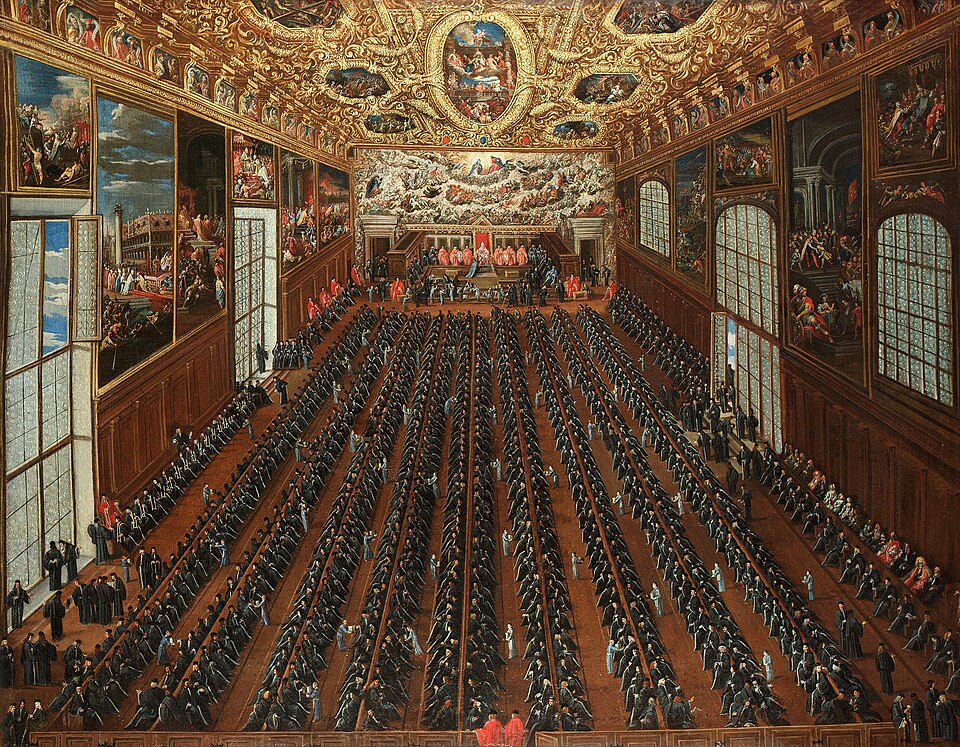
However, sortition is merely a tool. If all citizens participate as equals in the lottery, it is democratic. But if only a subset of wealthy families is allowed to participate in the lottery, it is aristocratic. Numerous medieval and Renaissance aristocratic Italian city-republics, such as Venice and Florence, combined sortition and election into a complex multi-level process. Sortition played a crucial role in overcoming and protecting against tyranny. There were many variations from city to city, and within any given city over time.
Great Council of Venice electing magistrates from among lottery selected nomineesⓘ
Joseph Heintz the Younger, circa 1648–1650. Patricians voting for new magistrates in the Sala del Maggior Consiglio, Doge’s Palace, Venice. Source: Wikimedia Commons / Bonhams · Public-domain painting.
Sortition was also a means of avoiding corruption due to a concentration of power, assuring true equality of opportunity, and affirming the right of the citizenry to self-govern. The ancient Athenians, and many Renaissance Italian city-states, believed that equal opportunity to serve was a cornerstone of political equality. In addition to sortition, the Athenian approach to self-governance also mandated relatively short terms and rotation of office. This can be generalized as the principle of rule and be ruled in turn.
Elected legislatures of today derive from repurposed chambers convened by monarchs to allow consultation with the of the kingdom. They were not purpose-designed for democracy, and are ill-suited for that purpose. While the at the beginning of the thirteenth century is often taught as being an important document in the history of “democracy”, it is more accurately viewed as formalizing power sharing and beginning the transition from pure monarchy to . Elections of representatives to parliament from the were added near the end of the thirteenth century, in what came to be known as the “model parliament”. As I will discuss in a later section, the American revolutionaries used this parliamentary chamber model in designing their own legislatures, with the expressed purpose of empowering what the Framers called the “natural aristocracy” of America, as opposed to the hereditary aristocracy of Britain.
The jury system we have today evolved from an early English system with roots coming from Viking and Norman occupations, rather than from Athenian democracy. Juries were originally select nobles whom the sheriff thought might know the facts of the case or the accused, and be trusted to look out for the king’s interests. When the Church banned clergy from involvement in in the thirteenth century, decisions of guilt or innocence devolved to the juries. In 1682, South Carolina became the first place in the Americas to institute lottery selection of jurors. By 1765, Sir William Blackstone, in his influential Commentaries on the Laws of England, which was re-published in the Americas before the Revolution, wrote that
a competent number of sensible and upright jurymen, chosen by lot from among those of middle rank, will be found the best investigators of truth, and the surest guardians of public justice … [a lottery jury system] preserves in the hands of the people that share which they ought to have in the administration of public justice, and prevents the encroachments of the more powerful and wealthy citizens. (Blackstone 1765)
Juries were seen as a popular against the risk of abuse by elected government and appointed judges. This protection was subsequently expanded by Amendment 7 in the Bill of Rights.
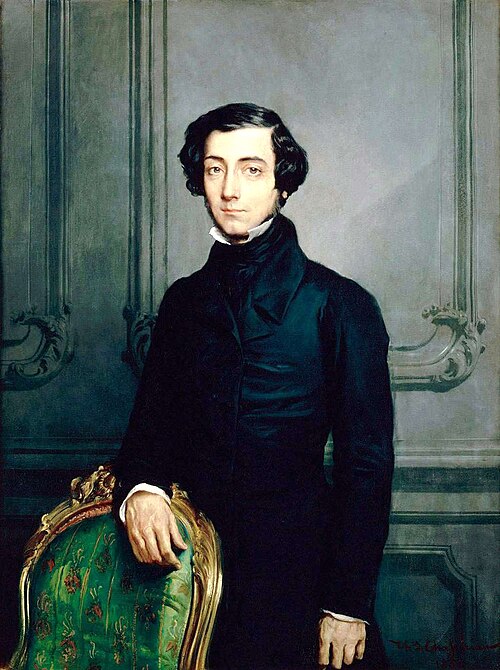
Alexis de Tocquevilleⓘ
Théodore Chassériau, nineteenth century. Wikimedia Commons · Public domain.
Alexis de Tocqueville wrote glowingly of the democratic importance of the American jury system:
[The] jury is before everything a political institution; one ought consider it as a mode of sovereignty of the people … It vests each citizen with a sort of magistracy; it makes all feel that they have duties toward society to fulfill and that they enter into its government. In forcing men to occupy themselves with something other than their own affairs, it combats individual selfishness, which is like the blight of societies … I think that the practical intelligence and good political sense of the Americans must principally be attributed to the long use that they have made of the jury in civil matters … Thus the jury, which is the most energetic means of making the people reign, is also the most efficacious means of teaching them to reign. (de Tocqueville [1835] 2012, 261–264)
A series of US Supreme Court rulings and the 1968 Federal Jury Selection and Service Act mandated that jury pools be “selected at random from a fair cross section of the community”. The US jury selection system, however, is distorted by the common practice of , in which the attorneys for each side seek to assemble a jury that will be biased in favor of their side by questioning and then dismissing some of the randomly selected jurors.
A Republic Rather than a Democracy
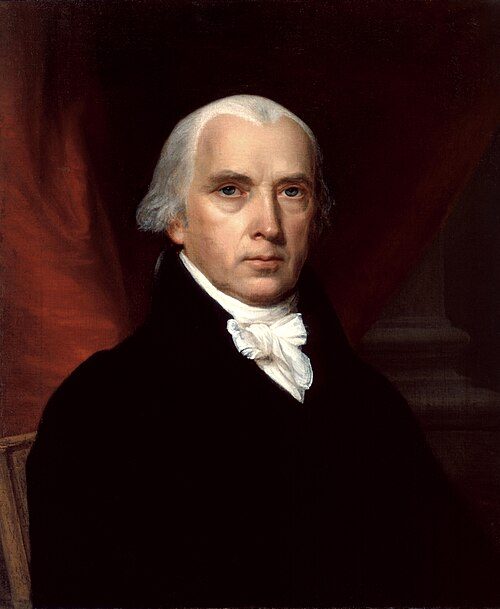
James Madison, “Father of the Constitution”ⓘ
John Vanderlyn, 1816. White House collection. Public domain. Madison’s familiar title recognizes his major contribution to the Constitution, not sole authorship. National Archives context. Image source.
Though the terms democracy and republic are often used interchangeably today, James Madison, like most political theorists preceding him, made a sharp distinction. Madison favored elite deliberation, within a competitive electoral framework, which he termed a republic, as distinct from a democracy. Most of the Framers of the Constitution, including Madison, disapproved of democracy, considering it a dangerous form of government that could endanger the “property rights” of the wealthy landowners and slaveholders.
The system of elections was not considered “democratic” by the Founders and Framers. Benjamin Rush, one of the signers of the Declaration of Independence, noted that while power may derive from the people, “they possess it only on the days of their elections. After this, it is the property of their rulers, nor can they exercise or resume it, unless it be abused” (as cited in Miller 2021, 92).
The Federalists believed that democracy was dangerous. They used democratic-sounding words, but sought to preclude actual democracy. As Joshua Miller wrote in The Rise and Fall of Democracy in Early America, 1630–1789,
The Federalists rendered the democratic vocabulary of popular sovereignty harmless by invoking a fictitious people who could never meet, never deliberate, never take action. The body politic became a ghost. Once the Federalists had conjured an imaginary ‘people’ who could not challenge the power of the national government, they became bold in declaring that the people had the right to decide, to act, and even to overthrow the government whenever they chose to do so. ()
Consent of the Governed versus Self-Rule
Consider the two phrases: “rule with the consent of the governed”, and “self-rule”. These terms are frequently used interchangeably, as if they were two ways of saying the same thing. But, on closer examination, they are completely different concepts. There is a fundamental distinction between consenting to an elite who would govern the people and everyday people being empowered to govern themselves.
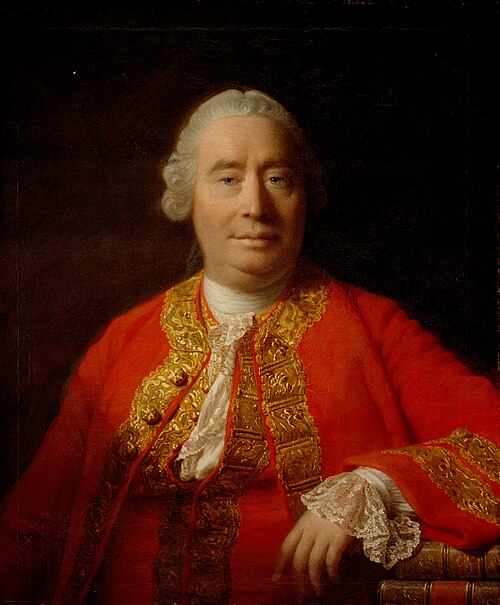
David Humeⓘ
Allan Ramsay, 1766. National Galleries of Scotland. Public domain. Image source
The Enlightenment notion of “consent” was not initially even based on elections at all. It was at best hypothetical, with theorists like Thomas Hobbes observing that the sovereign, who might be a hereditary monarch, could be deemed to have as long as the people didn’t emigrate or rise up in rebellion. Other Enlightenment theorists, such as John Locke, based consent on “” theory (which Thomas Jefferson enshrined in the Declaration of Independence). However, the Scottish philosopher David Hume in 1748 dismissed this concept of “tacit” consent, and Jeremy Bentham wrote his condemnation of as “rhetorical nonsense—nonsense on stilts” (Bentham [1796] 1843).
Some of the Framers asserted that a more democratic constitution could ironically increase the power of the wealthy (at the expense of the professional classes). One of the key authors of the Constitution, Gouverneur Morris, a delegate from Pennsylvania, argued that in a democracy, the rich could use their wealth to buy the votes of the poor, or whip up the people’s passions, and make these instruments for oppressing them, against their own and society’s best interests. Alex Keyssar observes in his The Right to Vote: The Contested History of Democracy in the United States, that the Framers “were performing an impressive feat of ideological alchemy: providing an ostensibly defense of an overtly anti-egalitarian policy” (Keyssar 2000, 11).
Many of the Framers making this argument on one day also expressed a concern on another day that the lower classes, rather than doing the bidding of the rich, would indeed pursue their own interests, leading to a redistribution of wealth. The Framers of the Constitution, as neatly encapsulated by historian John Keane, “thought in terms of the tricky political problem of how to go beyond a run by a monarch and a rump parliament, by building a republican form of government that kept its source of sovereignty—’the people’—at arm’s length from the levers of governmental power” (Keane 2009, 279).
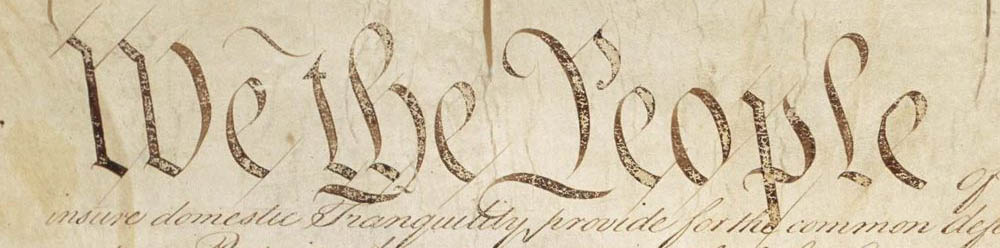
Although the Constitution begins with the stirring words “We the people …”, the vast majority of Americans were never consulted nor asked to consent. Madison expressed concerns about the risk of popular passions if the people ruled unfiltered by representatives. He wrote in Federalist Paper No. 63 that the new republic should be governed with the “total exclusion of the people, in their collective capacity” (Madison 1788).
Does choosing among candidates in an election imply consent by the voter in the entire system that proffers the election? The Rasmussen Reports polling firm has regularly asked Americans if they feel the federal government “has the consent of the governed”. In August of 2013, it reached an all-time low with just 17 percent agreeing. This means that most people who participated in elections did not feel that their mere voting granted consent (Rasmussen Poll 2014b). By 2018, despite the conflict between Democrats and Republicans through the Trump presidency, the percentage had climbed to 24 percent (Rasmussen Poll 2018).
There is also a distinction between giving consent to a specific government (or set of rulers) and consenting to an overarching framework of government that will establish the means of selecting and consenting to a series of future government authorities into the indefinite future. A people might consent to be governed by a specific beloved king, but that is not the same as consenting to be governed by all future royal heirs.
The Federalist Framers of the Constitution believed the new nation should be ruled by a “natural aristocracy,” as Jefferson called it (Jefferson 1813). There was a common attitude (at least among many of the elite) that wisdom and civic virtue were associated with the ownership of property. Madison argued that a democracy would not produce leaders “who possess the most attractive merit and the most diffusive and established characters” (Madison 1787b). But the protection of property wealth seems to have always been at the back of his mind. He agreed that the Senate should be structured to protect the wealthy from the many.
In notes of the secret debates at the Constitutional Convention, Madison is quoted as expressing worry about the threat of land redistribution, saying:
our government ought to secure the permanent interests of the country against innovation. Landholders ought to have a share in the government, to support these invaluable interests, and to balance and check the other. They ought to be so constituted as to protect the minority of the opulent against the majority. (Yates 1787)
While many Americans today cherish the Constitution as a virtually sacred, inerrant model for “democracy,” the Founders and Framers of the Constitution did not hold this view at all. Thomas Jefferson believed the Constitution should sunset every 19 years. In an 1816 letter, he wrote:
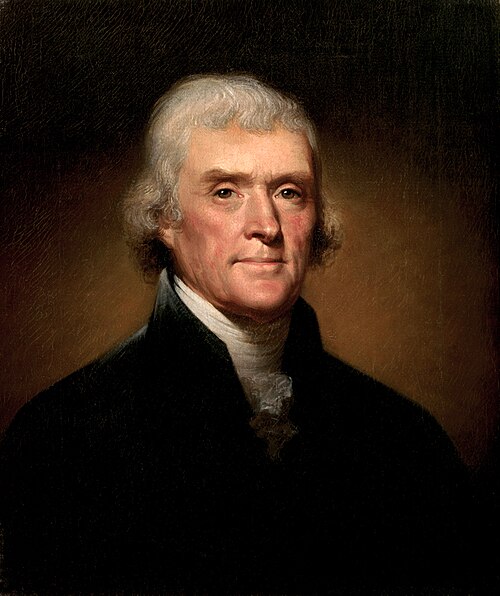
Thomas Jeffersonⓘ
Rembrandt Peale, 1800. White House collection. Public domain. Image source
Some men look at constitutions with sanctimonious reverence and deem them like the ark of the covenant, too sacred to be touched. They ascribe to the men of the preceding age a wisdom more than human, and suppose what they did to be beyond amendment. I knew that age well; I belonged to it, and labored with it. It deserved well of its country. It was very like the present, but without the experience of the present; and 40 years of experience in government is worth a century of book-reading; and this they would say themselves, were they to rise from the dead. But I also know that laws and institutions must go hand in hand with the progress of the human mind. As that becomes more developed, more enlightened, as new discoveries are made, new truths disclosed, and manners and opinions change with the change of circumstances, institutions must advance also, and keep pace with the times. We might as well require a man to wear still the coat which fitted him when a boy … (Jefferson 1816)
George Washington, in 1787, wrote:
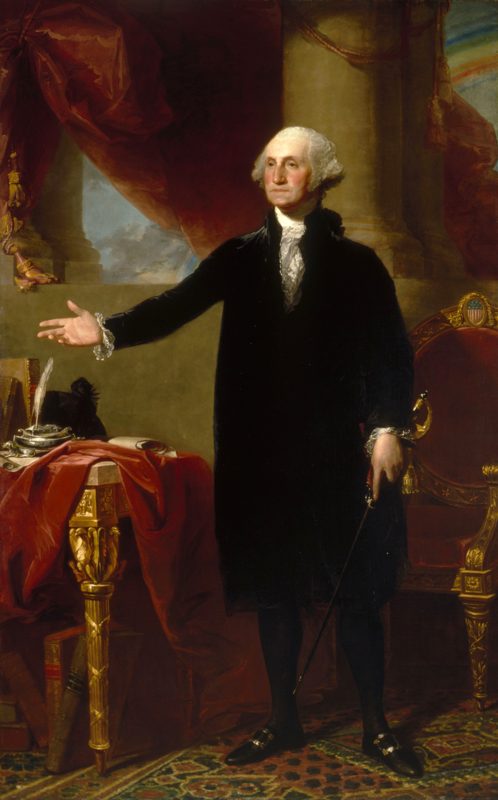
George Washingtonⓘ
Gilbert Stuart, 1796. Lansdowne portrait, National Portrait Gallery, Smithsonian Institution. Public domain. Image source.
I think the people (for it is with them to judge) can, as they will have the aid of experience on their side, decide with as much propriety on the alterations and amendments which shall be found necessary, as ourselves; for I do not conceive that we are more inspired—have more wisdom—or possess more virtue than those who will come after us. (Washington 1787)
The Founders gave us explicit advice to periodically reconsider the choices they had made about how we should govern ourselves today.
The French Revolution and Elections
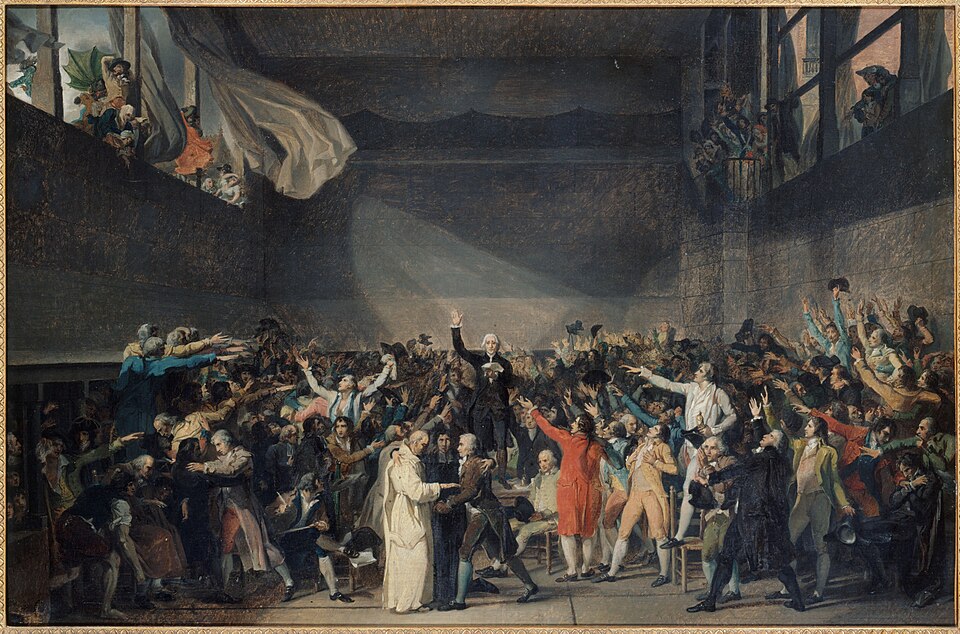
The Tennis Court Oath, 1789.ⓘ
On 20 June 1789, deputies meeting at an indoor tennis court in Versailles pledged to remain together until France had a constitution. The gathering challenged royal authority and became a defining event of the French Revolution. This image is Jacques-Louis David’s later depiction, rather than an eyewitness photograph. Further background.
Jacques-Louis David’s later depiction, 1790s. Musée Carnavalet. Wikimedia Commons · Public domain.
The elected leaders of the French Revolution, like their American counterparts, were inspired by the “natural rights” theory and consent. They also disdained democracy in favor of an elite-ruled republic. Some years into the Revolution, the president of the National Assembly, Boissy d’Anglas, gave a speech which summarized his elite vision for the republic.
We should be governed by the best among us; the best are the most highly educated, and those with the greatest interest in upholding the laws; save for the rarest exceptions, you will only find such men among those who, by reason of their owning property are devoted to the land in which it is situated … If you were to grant unlimited political rights to men without property, and if they were ever to take their place in the legislative assembly, they would provoke disturbances, or cause them to be provoked, without fear of the consequences … (quoted in McPhee 2001, 160)
Montesquieuⓘ
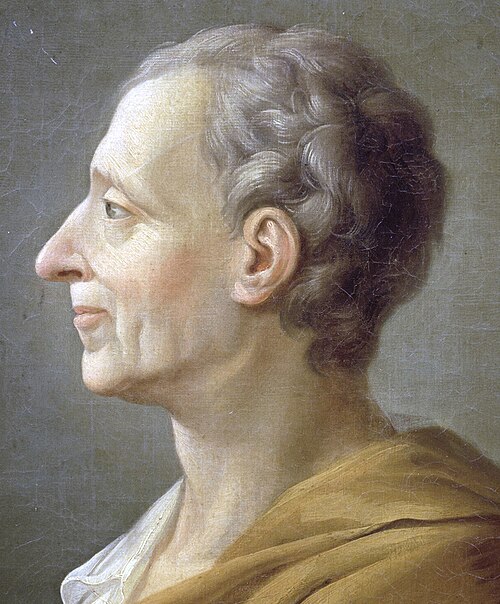
Montesquieu (1689–1755) was a French political thinker, best known for The Spirit of the Laws (1748). His account of separating government powers influenced constitutional design. Terry discusses him here as a writer who distinguished selection by lot from election. Further background.
Portrait after Jacques-Antoine Dassier; artist unknown, eighteenth century. Wikimedia Commons · Public domain.
Jean-Jacques Rousseauⓘ
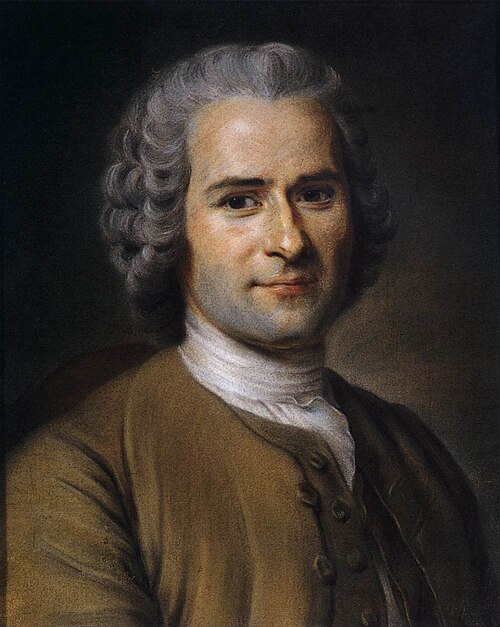
Jean-Jacques Rousseau (1712–1778) was a Genevan philosopher whose The Social Contract (1762) placed sovereignty in the people collectively. His distinction between the people’s authority and the government carrying out their laws helps explain the chapter’s concern with who actually rules. Further background.
Maurice Quentin de La Tour, 1753. Wikimedia Commons · Public domain.
The aristocratic nature of elections was well understood. In his 1997 book The Principles of Representative Government, Bernard Manin coined the term principle of distinction to describe this fundamental characteristic of elections. It is the very essence of elections for people to want to vote for people who stand out as distinct, or who can project an air of self-confidence and “superiority”. The highly influential Baron de Montesquieu in 1748, had written that elections were the appropriate tool for an aristocracy, while selection by lot was natural to democracy. This understanding—that elections were oligarchic and sortition democratic—was restated by Rousseau in The Social Contract, published in 1762. Bernard Manin argues this “distinction” sentiment won out in the eighteenth century, as the anti-democratic framers of both the American and French constitutions, who themselves had won elections, saw the election of politicians as more desirable than the democratic lot.1
Notes
Like the comparable US documents, the language of the Declaration of the Rights of Man and Citizen and the rest of the revolutionary Constitution had a universal ring, but rights were , with male property owners over the age of 25 being deemed “active citizens,” while the bulk of society was relegated to the status of “passive citizens,” and could not vote, nor serve in office. This distinction, crafted by the political philosopher and republican, Emmanuel Joseph Sieyès, provided the justification for denying equal rights to the poor. The of wealthy elites among those elected helps explain the passage of the Le Chapelier Law of 1791, which banned guilds, and workers’ associations (precursors to unions) and made labor strikes against the law. ↩ Return to text
Hume and tacit consent
Hume questioned whether remaining in a country amounts to freely consenting to its government. A person living on meagre wages, unfamiliar with foreign languages and customs, may have little practical chance to leave. Staying therefore does not, by itself, establish voluntary agreement to be governed.
Miller, Joshua. 1991. The Rise and Fall of Democracy in Early America, 1630–1789: The Legacy for Contemporary Politics. University Park, PA: Pennsylvania State University Press.
Yates, Robert. 1787. “Notes of the Secret Debates of the Federal Convention of 1787, Taken by the Late Hon Robert Yates, Chief Justice of the State of New York, and One of the Delegates from That State to the Said Convention”. Accessed February 26, 2023. https://avalon.law.yale.edu/18th_century/yates.asp
Washington, George. 1787. “Founders Online: From George Washington to Bushrod Washington, 9 November 1787”. National Archives and Records Administration. Accessed August 26, 2023. https://founders.archives.gov/GEWN-04-05-02-0388